malaysian naturalist, march 2015
Text and images by Steven Wong
I OFTEN get weird looks when I tell people that my hobby is “herping”. The looks are then followed by “What’s that?” or “Oh, you plant herbs”, and I would have to go into a lengthy, pre-prepared response to explain one of my greatest interests in life.
Herping is shortened from herpetology, the scientific study of reptiles and amphibians. Just as scientists studying birds are ornithologists and amateur observers of birds are birders, amateur or enthusiast observers of reptiles and amphibians (also known as herps) are herpers, which may draw even more quirked eyebrows as it sounds a lot like a certain sexually transmitted disease. Herpetology and herpes share the same Greek root word, herpein, which means to creep, exactly what shingles and lizards do.
Herpetofauna is an arbitrary group of animals. Amphibians are not very closely related to reptiles; in fact, birds are more closely related to lizards than are frogs or salamanders. They were just grouped together as they are both relatively small groups of animals and have similar habitat preferences and ecology.
Herping is shortened from herpetology, the scientific study of reptiles and amphibians. Just as scientists studying birds are ornithologists and amateur observers of birds are birders, amateur or enthusiast observers of reptiles and amphibians (also known as herps) are herpers, which may draw even more quirked eyebrows as it sounds a lot like a certain sexually transmitted disease. Herpetology and herpes share the same Greek root word, herpein, which means to creep, exactly what shingles and lizards do.
Herpetofauna is an arbitrary group of animals. Amphibians are not very closely related to reptiles; in fact, birds are more closely related to lizards than are frogs or salamanders. They were just grouped together as they are both relatively small groups of animals and have similar habitat preferences and ecology.
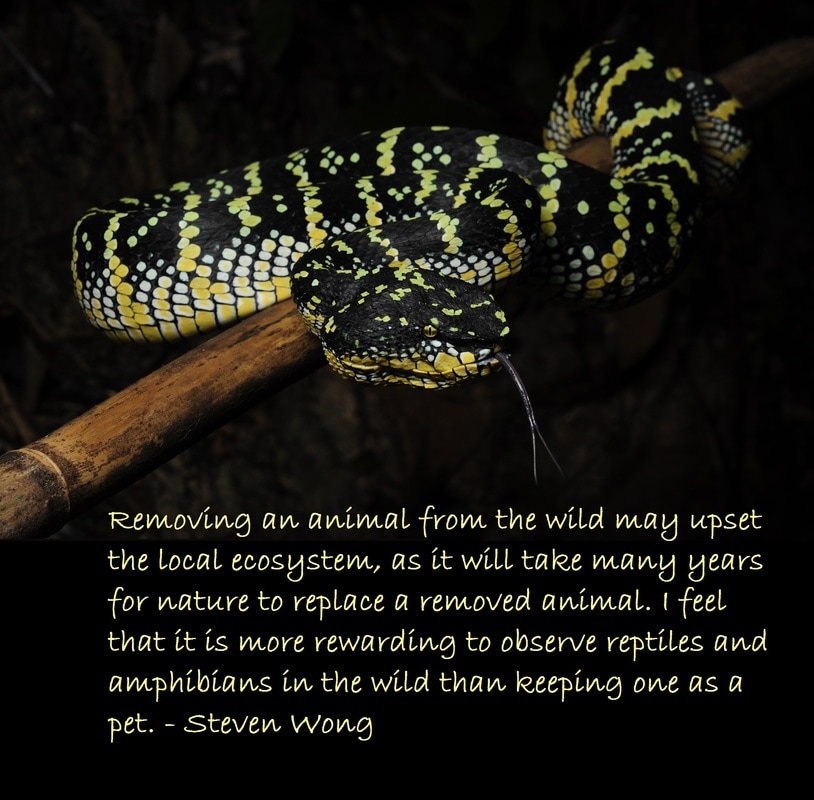
So what do herpers actually do? They find and observe herpetofauna and photograph them. Some are happy enough just to be able to see them. Many people with interest in reptiles and amphibians often buy and keep them as pets. While I think that pet keeping is a great hobby for kids as it teaches them to be responsible for the wellbeing of the animal, I personally do not condone the act of capturing and keeping wild creatures as pets. Removing an animal from the wild may upset the local ecosystem, as it will take many years for nature to replace a removed animal. I feel that it is more rewarding to observe reptiles and amphibians in the wild than keeping one as a pet.
I also find it very interesting to observe herps in their natural habitat as this provides some insight into the animals’ habitat preferences and life history. Finding these animals, especially rare ones, is challenging and can be especially exciting. Herping is a fun and enjoyable activity that anyone can engage in. Malaysia has a great range in amphibian and reptile diversity. Herps can be found in lowland rainforests, riparian habitats, highland rainforests and even in semi-disturbed habitats, such as public parks, fields and secondary forests.
I also find it very interesting to observe herps in their natural habitat as this provides some insight into the animals’ habitat preferences and life history. Finding these animals, especially rare ones, is challenging and can be especially exciting. Herping is a fun and enjoyable activity that anyone can engage in. Malaysia has a great range in amphibian and reptile diversity. Herps can be found in lowland rainforests, riparian habitats, highland rainforests and even in semi-disturbed habitats, such as public parks, fields and secondary forests.
One of the easiest herps to find is the frog. In secondary forests with streams or ponds, you can expect to find up to 10 species of frogs in a night of herping. Frogs need to keep their skin moist for effective oxygen exchange through their skin, thus most frogs are nocturnal. In the day, frogs hide from the sun in leaf litter, under rocks and in burrows or tree holes. The easiest way to find frogs at night is by looking for their eyeshine with a bright headlamp. Frogs have dull white eyeshine, unlike the bright blue-green or orange eyeshine of mammals or insects.
Most lizards are diurnal; they actively forage for prey in the day and can be easily spotted while moving or sunning themselves on branches, but can also be found sleeping on trees at night. Snakes are mostly nocturnal, though a great many are diurnal. Snakes can normally be found moving in trees or on the ground looking for prey. Arboreal snakes can be found by looking for their bright ventral scales.
Here I must emphasise the importance of not handling snakes without knowing if they are venomous. Ultimately, it is best to not handle snake at all as they get stressed quite easily. Bites from non-venomous or mildly venomous snakes may not kill, but may still cause quite a bit of pain and discomfort.
I hope my short guide and these pictures have piqued your interest to grab a head lamp and start on your herping adventure. With over 180 species of frogs and 150 species of snakes to find, and more discovered every day in remote locations, it will be a long while before you see every type of herp that Malaysia has to offer.
Most lizards are diurnal; they actively forage for prey in the day and can be easily spotted while moving or sunning themselves on branches, but can also be found sleeping on trees at night. Snakes are mostly nocturnal, though a great many are diurnal. Snakes can normally be found moving in trees or on the ground looking for prey. Arboreal snakes can be found by looking for their bright ventral scales.
Here I must emphasise the importance of not handling snakes without knowing if they are venomous. Ultimately, it is best to not handle snake at all as they get stressed quite easily. Bites from non-venomous or mildly venomous snakes may not kill, but may still cause quite a bit of pain and discomfort.
I hope my short guide and these pictures have piqued your interest to grab a head lamp and start on your herping adventure. With over 180 species of frogs and 150 species of snakes to find, and more discovered every day in remote locations, it will be a long while before you see every type of herp that Malaysia has to offer.